Wednesday, February 11, 2015

Wellness Wednesday

When I watched the movie Food Inc., I was disturbed by a scene where a low-income family was comparing the price of the foods on a dollar menu at a fast food restaurant to the cost of an organic apple. The family used that comparison to prove that they could not afford to eat healthy. And that has been bothering me for years because 1) it was almost an apples to oranges comparison (in this case apples to fries); 2) the apple was probably out of season and it definitely wasn't local; and 3) they didn't show there was a middle ground - conventional whole foods are still better than fast food.

I recently started thinking about how some processed foods compared, pound-for-pound, with conventional produce. Today, while at our local grocery store (part of a nation-wide chain), I checked on the price of Doritos. Even on "sale," the price worked out to $3.99 a pound! I compared that to apples which were $0.79 a pound. Certainly makes the chips look over priced. And of course, you get health benefits from the apple; you get...fat from the chips. I also checked out the price of conventional brown rice. It was $0.77 for a one pound bag that makes 11 servings. That's 7 cents a serving.
Potato Texture
Source
So my health tip today is to compare prices by looking at the size and weight. (The Doritos at $3.99 a pound was a real eyeopener.) While not everyone can afford to purchase all their groceries at a place like Whole Foods, don't overlook the great deals on frozen fruits and vegetables, whole grains such as brown rice, dried beans, and even fresh produce that is in season. Not only is it healthier, but real food will fill you up. Think about how many chips you need to eat before feeling full and then consider how many potatoes it would take to fill your stomach. Not only will, pound-for-pound, the potatoes be cheaper, you will eat less which will make your money stretch even further.

Monday, February 9, 2015

Monday Amusement

Some of you may remember that I'm rereading The Artist's Way as part of my morning reading. It's a 12 week program to help claim or reclaim your artistic self. I'm taking my time reading through it; not necessarily doing it in 12 weeks. However, I'm at the point where my assignment is to have one week of reading deprivation. Yes, you read that right - reading deprivation. As someone who started on her reading journey at the age of 3 - I can't even remember NOT knowing  how to read - that's a tough one for me. But, as the author Julia Cameron points out, words can act as tranquilizers to people. We're so busy reading, learning, researching, discovering, that we have a hard time doing. It's like the Pinterest trap. We all pin things to our boards on Pinterest but we rarely take the time to try to create the meals, do the craft project, or try the home remedy.

So this week, as part of my reading deprivation, I can't go surfing the internet, looking for interesting things for my readers. If I haven't already discovered it, it won't be on my blog this week.

For today's amusement, I decided to show some goat pictures. These may or may not be amusing to other people, but I find my goats to be an endless source of amusement. Now that we have 20 kids on the farm, it's non-stop entertainment. Here are some of the goats from our front pasture:

Bianca, with her sister Jade, checking to see if I have a treat

Madonna with her latest kid

Kids hanging out with one of the moms

Despite the demonic look in her eyes, Donna is a good mother.
Her kid was too weak to nurse so we had to help her out,

Sunday, February 8, 2015

Quote for the Day

"Unfortunately, the extensive moralizing within the ecological movement has given the public the false impression that they are being asked to make a sacrifice - to show more responsibility, more concern, a nicer moral standard. But all of that would flow naturally and easily if the self were widened and deepened so that the protection of nature was felt and perceived as protection of our very selves. . . the obvious choice, then, is to extend our notions of self-interest. For example, it would not occur to me to plead with you, 'Don't saw off your leg. That would be an act of violence.' I wouldn't occur to me (or to you), because your leg is part of your body. Well, so are the trees in the Amazon rain basin. They are our external lungs. We are beginning to realize that the world is our body." 
~Joanna Macy

Friday, February 6, 2015

Farm Friday

In keeping with my desire to live a simpler, more clutter-free life, on Sunday I suggested we go through some of the books in our basement and pick out some, one shelf at a time, to edit from our collection. While my mind is already there, Bill's is not; he didn't see a single book that we should eliminate. Instead, he asked me about some plastic bags I had stored on some other shelves. I reminded him those held books, magazines, and other papers I had saved from the farmhouse before we renovated it. I had put them in sealed plastic bags because, having spent decades in a vacant dilapidated house, they were filled with silverfish and other creepy crawlies that I wanted to kill. Since they had been bagged up for years it was a safe bet that everything in them was dead and we could now open them. We only opened a couple of the bags and here are some items of interest:


This is a political magazine for women dated July 7, 1928. What was especially interesting was finding this straw poll ballot and seeing who was running for president that year, and most interesting, the political parties listed:
Another find were these cutouts from magazines.


I assume the cutouts were intended to be used as paper dolls (anyone remember those?). Someone spent a lot of time and skill carefully cutting out these figures. In our culture, we wouldn't dream of turning magazines into toys; however, in those days, most people didn't have a lot of money and so were very creative.

On an afternoon walk with my faithful Ginny, I realized Georgia was looking a bit shabby:

It's time to get her some new clothes! She missed Gasparilla, but just might make Mardi Gras this year.

Last week we added four new girls to our chicken flock, purchased from a woman who clearly cared for them as they are friendly as can be. Unfortunately, when she got the hens, two of them were debeaked (she said she didn't know why) and they will always be at the bottom of the pecking order.

The goat babies continue to come. We now have 20 and think that should be about it for this season. Neo and Pearl continue to be spoiled bottle babies, escaping the pasture around their mid-day feeding, running in search of "mama" and "daddy." 

Have a great week!

Thursday, February 5, 2015

Strengths and Weaknesses

One morning, Bill and I were having one of our typical serious conversations. We got on the topic of the Food Freedom Act which failed in committee in VA. This bill would have allowed individuals to sell a wide variety of food items directly to consumers (i.e., their neighbors) without the expense of getting your kitchen inspected, paying huge fees for the inspections and equipment, and so forth. Then I mentioned Obama's proposed "new agency to make Americans' food safer." This led us to talk about our dependence on California for most of our food and some of the crazy supply lines we have for a variety of other commodities. At that point, a visual came to me (I'm a very visual person) that I had to sketch out. I told Bill that one side of the sketch represented our current system for food (and all sorts of other things) and the other side showed how our system(s) should be. I said that while I don't know a lot about engineering or architecture I was pretty sure a physical structure built along the lines of the first would be a disaster - a huge one - waiting to happen, while the second diagram would be a strong, resilient structure (or system).

The following photos give you an idea what my sketch showed. Our current system for food, government, energy, etc. is similar to this wagon wheel:


Wheathered Old Cartwheel
Source
The hub (or center) is where everything happens and everything radiates out from there. The spokes all depend upon the hub. Should one spoke go out, the system still works, but is very weak. However, if the hub is damaged the entire system fails. The centralized model is extremely flawed.

On the other hand, a system based on something like this honeycomb
Honey Comb
Source
or this grid
Unstructured grid.svg
Source
would be resilient. Take out any one section - or even several - and the system would stand strong. It is both interdependent and independent, which is the key to its strength. A great example of a grid is the internet, where we have thousands and thousands of servers making it work. Should one server fail, the entire system is not taken down.

This is what we need to move towards, for food security, energy security, economic security. Not the hub-style system where there is only dependence upon centralized control or supply. Since we know problems can and do occur, it's just a matter of waiting for it to happen. History has shown this time and time again. 

When I worked for a large corporation and made travel plans for the executives, we had a policy of never allowing more than three directors on the same flight. While it was sometimes annoying and inconvenient, we learned how important it was after Air Florida flight 90. The company I worked for had customers on that flight. As a matter of fact, their entire team was on that flight. Not one survived, so not only was it a tragedy for their loved ones, it was also a disaster for the company. Lessons learned - maybe.

In Virginia, this was our second go around with a proposed bill for expanded local food sales, which would be good for small farms, small businesses, people who want to work from home (such as single parents who can then avoid child care and other expenses), etc. and good for a resilient local economy. It was killed in committee this week. We now understand more clearly how our local politicians, who complain about big government regulation, are more swayed by the Big Ag money that keep them in office. (It's easy to check out who fills their coffers during campaigns.) Now we know it's all about money and power - not about individual freedom and rights. I know it shouldn't come as a surprise to me, but I'm still disappointed in our elected officials.

Although the politicians say it would be dangerous for neighbors to buy food from one another, they would never think to regulate church pot luck meals or any other communal meal. And they never point out that the real dangers in food always come from the large companies that end up having to recall food across the nation after people suffer from sickness and sometimes even death from the tainted food that is supposed to be safe, inspected, and regulated. Small businesses are not dangerous to people - they're dangerous to large corporations.


Goodnight Democracy from BillMoyers.com on Vimeo.

The machinations of government have increasingly become transparent. You cannot continue to parade the need for safety while supporting systems that are extremely fragile and (as with the case of food recalls, grid meltdowns, etc.) dangerous without someone taking notice.


See on Facebook

Wednesday, February 4, 2015

Wellness Wednesday

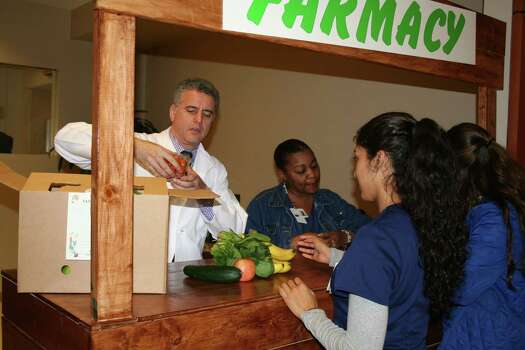
A quick post today but something to think about - medical doctors prescribing food to patients for what ails them. Not only that, but getting it in the same manner that many American's get their pharmaceuticals - conveniently located near or at the medical facilities - and, similar to having an insurance co-pay/reimbursement plan, you don't pay full price.
Dr. Garth Davis and Renee Garrett explain what comes in a Farmacy box before presenting Luci Lopez with her prescription order. Photo: Tom Behrens
This "farmacy" in Houston is just such a program. After noticing that many of his patients' health problems were linked to lifestyle - specifically diet, Dr. Garth Davis partnered with an organic food co-op to start prescribing fresh fruits and vegetables. 

Eating fresh fruits and vegetables, along with whole grains and other whole foods, is a great way to protect and improve your heath. Plus those foods taste so much better than processed foods. A win-win!

Monday, February 2, 2015

Monday Morning Amusement

Good for some belly laughs:


27 Hilarious Test Answers That Aren’t Technically Wrong


1.

To be fair he did find X.

2.

3.

4.

Exactly.

5.

6.

This is actually correct.

7.

8.

This kid is onto something.

9.

10.

11.

YES.

12.

13.

14.

Because, MATH.

15.

16.

17.

18.

19.

DUH.

20.

21.

Probably. VERY

22.

23.

24.

Smart kid.

25.

26.

Straight up risky.

27.

(Source)